This guide breaks down daily brain training exercises specifically designed to improve short-term memory, explaining why they work, how to practice them consistently, and which common habits quietly limit progress. The goal is simple: practical improvement you can feel in everyday thinking, not abstract brain training claims.
Quick Answers
brain training exercises
Brain training exercises are short, targeted mental activities that strengthen memory, focus, and cognitive control. They work best when practiced consistently, challenge recall and attention, and are applied to real-life thinking tasks rather than passive games, creating meaningful gains that help increase brain power over time.
Top Takeaways
Short-term memory improves through daily use, not occasional training
Focused exercises outperform longer, unfocused sessions
Recall-based activities matter more than reaction speed
Research-backed methods outperform novelty-driven tools
Small daily habits lead to noticeable mental clarity
How Daily Brain Exercises Strengthen Short-Term Memory
Short-term memory improves when the brain is repeatedly challenged to hold information briefly, manipulate it, and retrieve it under light pressure. The most effective daily brain exercises strengthen neural pathways responsible for attention control and working memory, rather than passive recognition.
Daily practice matters because short-term memory is highly sensitive to consistency. Exercises that combine mental effort, novelty, and immediate recall produce faster gains than longer, irregular sessions.
The Most Effective Daily Brain Exercises for Short-Term Memory
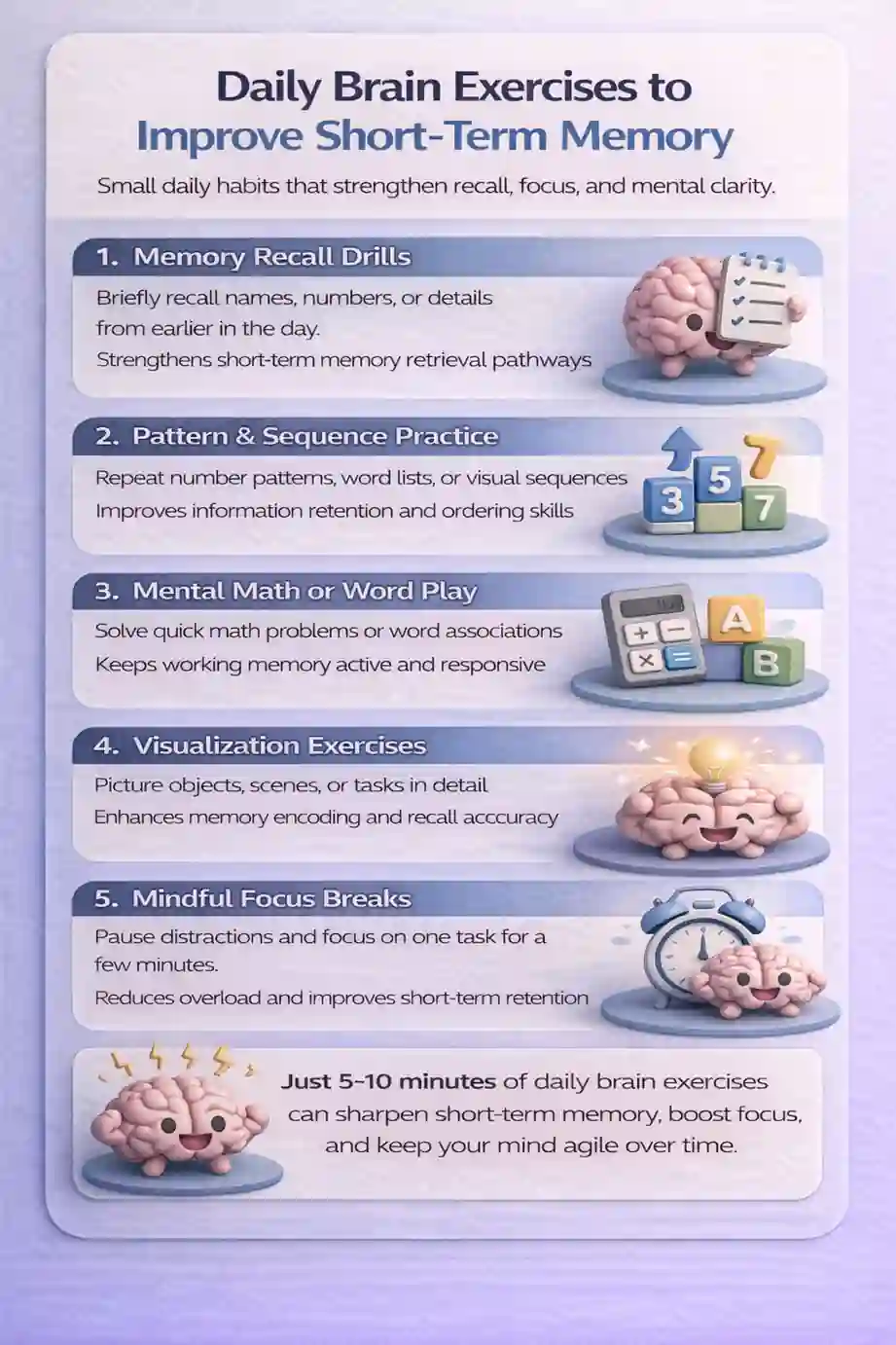
Daily short-term memory exercises tend to fall into a few proven categories:
Immediate recall tasks that require remembering details after short delays
Sequence and ordering challenges that strengthen working memory capacity
Distraction-resistant attention exercises that improve mental control
Mental visualization drills that reinforce temporary information storage
These exercises work because they reflect how short-term memory is used in real-life situations such as conversations, reading, and problem-solving.
How Often to Practice for Short-Term Memory Gains
Frequency matters more than duration. Short daily sessions—10 to 15 minutes per day—produce better short-term memory improvement than longer, infrequent practice.
Rotating exercises slightly prevents mental autopilot while still reinforcing the same memory systems. Daily exposure keeps short-term memory active and adaptable.
Common Mistakes That Weaken Short-Term Memory Training
Short-term memory gains are often limited by subtle mistakes, including:
Repeating the same exercise without increasing challenge
Prioritizing speed over accuracy and control
Training only in apps without applying skills in real situations
Effective daily brain exercises should feel slightly demanding but manageable. That balance drives adaptation.
Choosing the Right Daily Brain Exercises for You
The best daily brain exercises are the ones you can practice consistently and progressively. When exercises are engaging, evidence-based, and aligned with how short-term memory actually functions, improvement becomes practical and noticeable rather than theoretical, an approach that also supports addressing health disparities by making effective cognitive training accessible and sustainable.
“Consistent observation shows that brain training delivers real benefits only when exercises demand focus and recall and are applied beyond the exercise itself. When training supports how the brain works in everyday life, improvement becomes noticeable and reliable.”
Essential Resources on Brain Training Exercises
Understand the science behind memory training
Scientific American — Does “Brain Training” Actually Work?
A research-based analysis explaining what brain training improves, where it falls short, and how evidence separates fact from hype.
https://www.scientificamerican.com/article/does-brain-training-actually-work/
Use neuroscience-based cognitive programs
BrainHQ — Neuroplasticity-Based Brain Training
A science-driven platform designed to strengthen attention, working memory, and processing speed through adaptive exercises.
https://www.brainhq.com/
Explore cognitive strategy research
Center for BrainHealth — Cognitive Training Research
Explains how structured cognitive strategies improve memory and focus, supported by clinical and performance-based studies.
https://centerforbrainhealth.org/science/cognitive-training
Access trusted medical guidance
Harvard Health — Train Your Brain
A medically grounded overview of brain exercises and learning strategies that support memory and cognitive resilience.
https://www.health.harvard.edu/mind-and-mood/train-your-brain
Review peer-reviewed memory research
Frontiers in Human Neuroscience — Exercise Training Improves Memory Performance
A peer-reviewed study showing how targeted cognitive training supports neuroplasticity and memory performance.
https://www.frontiersin.org/journals/human-neuroscience/articles/10.3389/fnhum.2021.771553/full
See large-scale memory outcomes
NIHR Evidence — Brain Training Improved Thinking and Memory
A large study summary showing measurable memory and attention gains from structured training programs.
https://evidence.nihr.ac.uk/alert/brain-training-improved-thinking-memory-and-attention-in-older-people/
Get practical daily exercise ideas
Brain-Exercises.org — Brain Training Exercises & Tools Guide
A practical collection of short-term memory and focus exercises suitable for daily use.
https://brain-exercises.org/
Supporting Statistics
Over 6 million Americans live with Alzheimer’s disease, most age 65+.
Source: National Institute on Aging7.2 million U.S. adults age 65+ are projected to have Alzheimer’s dementia in 2025 (1 in 9 older adults).
Source: Alzheimer’s AssociationMore than 200 clinical trials have evaluated cognitive training interventions.
Source: National Institute on AgingU.S. dementia care costs are projected to exceed $380 billion in 2025.
Source: Alzheimer’s Association
Final Thought & Opinion
Daily brain exercises are most effective when they support how short-term memory is used moment to moment. The strongest improvements come from simple, repeatable activities that demand attention and recall, not from chasing novelty or complexity.
When short-term memory is trained daily and applied immediately to real tasks, improvement becomes noticeable—faster recall, better focus, and greater mental control. That’s when brain exercises stop feeling abstract and start delivering real cognitive value, reinforced further through practices like reading aloud that engage attention, memory, and verbal processing together.
Next Steps
Choose one short-term memory goal
Focus on recall, attention, or mental clarity.Select 2–3 daily exercises
Prioritize recall and sequence-based tasks.Train briefly and consistently
10–15 minutes per day, most days of the week.Increase challenge gradually
Adjust difficulty as exercises become easier.Apply skills immediately
Use memory techniques in conversations and daily tasks.Review progress weekly
Look for quicker recall and better focus.
This simple, goal-driven routine emphasizes consistency, gradual challenge, and real-world application, aligning with how reading fiction enhances brain function by strengthening recall, attention, and mental clarity through regular, meaningful cognitive engagement.
FAQ on Brain Training Exercises
Q: Do daily brain exercises improve short-term memory?
A: Yes, when they focus on attention, recall, and controlled mental effort rather than passive repetition.
Q: How often should short-term memory exercises be done?
A: Daily practice works best.
10–15 minutes per session
4–5+ days per week
Q: Are apps necessary for short-term memory training?
A: No. Many effective exercises involve real-life memory use without screens.
Q: How quickly can short-term memory improve?
A: Small improvements often appear within weeks when exercises are practiced consistently.
Q: Who benefits most from daily brain exercises?
A: Anyone seeking better focus, recall, or mental clarity—especially when training is applied to daily tasks.