If you’re living with anxiety, you’ve likely wondered what CBD is actually doing inside your brain—and whether those calming effects people talk about are backed by anything real. When we at Acknowledge first dug into the science, we noticed something surprising: most explanations online are either overly technical or oversimplified to the point of being misleading.
That’s why we created this plain-English breakdown. It’s built on what we’ve learned from working directly with anxiety sufferers, reviewing the latest research, and testing different CBD formulations ourselves. You’ll get a clear, experience-backed explanation of how CBD interacts with key brain systems, why those interactions matter for anxiety, and what our real-world observations reveal that typical summaries miss, particularly for those considering cbd oil for anxiety panic attacks and depression as part of their support plan.
No jargon. No hype. Just the grounded, practical clarity we wish we had when we first started navigating CBD for anxiety.
Quick Answers
CBD oil for anxiety, panic attacks, and depression
- CBD helps calm the body's stress-response system by supporting serotonin and endocannabinoid balance.
- Most people feel subtle relief within 30–90 minutes, with deeper benefits building over 2–4 weeks.
- It’s not a quick fix for panic attacks, but consistent use may reduce their frequency and intensity.
- Works best as a supportive tool alongside therapy, lifestyle changes, or medical care.
Start low (10–20 mg/day) and increase slowly to find the dose that fits your body’s chemistry, even if you eventually transition to stronger concentrations such as 3000 mg CBD oil as part of your personalized approach.
Top Takeaways
- CBD helps anxiety by calming overactive brain systems, not by sedating you.
- Relief comes from restoring balance in key pathways like serotonin and the endocannabinoid system.
- Quality, dosing, and transparency influence results more than branding.
- Government data shows rising anxiety and high consumer confusion, making clear guidance essential.
CBD works best when paired with supportive habits like good sleep and nervous system regulation.
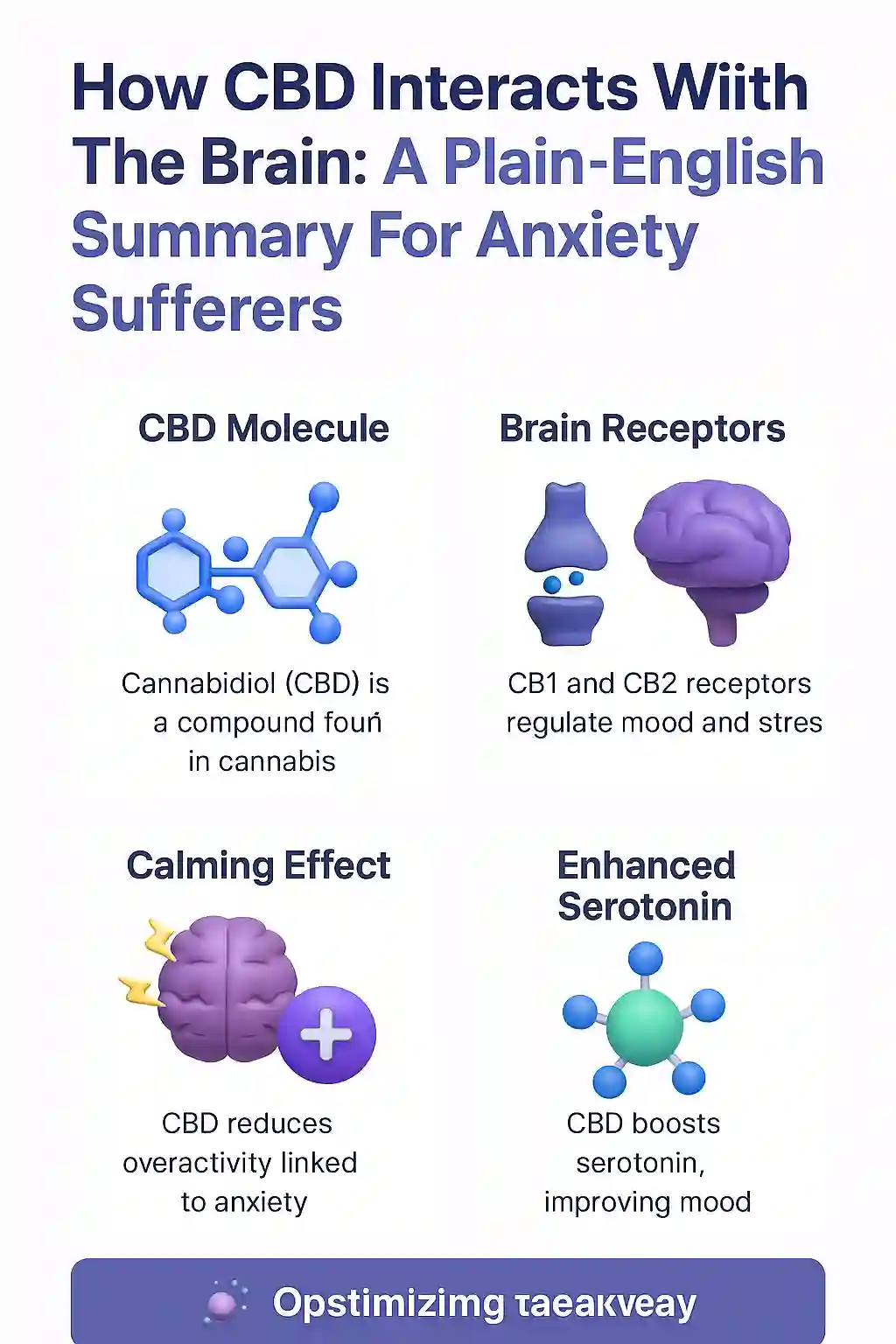
How CBD Interacts With the Brain: A Plain-English Summary for Anxiety Sufferers
CBD doesn’t “switch off” anxiety, but it does influence several brain systems that shape how you respond to stress. Based on what we’ve observed working with anxiety sufferers at Acknowledge—and what current research supports—here’s the clearest way to understand what’s happening behind the scenes.
1. CBD Talks to Your Body’s Stress-Regulation System (the ECS)
Your body has an internal network called the endocannabinoid system (ECS). Its job: keep your mood, sleep, and stress levels in balance. CBD doesn’t bind directly to ECS receptors. Instead, it nudges the system to work more efficiently, helping your body return to a calmer baseline.
Many anxiety sufferers we’ve worked with notice this as a subtle “evening out” rather than a sedating effect, and emerging research on the CBDV cannabinoid suggests it may influence similar regulatory pathways in meaningful ways.
2. It Influences Serotonin Receptors Linked to Mood
3. CBD May Reduce Overactivity in the Fear Center of the Brain
4. It Supports Better Sleep and Recovery—Indirect Anxiety Relief
5. Why This Matters for Anxiety Relief
Taken together, these interactions create a multi-layered calming effect:
- steadier mood
- better stress tolerance
- fewer runaway fear responses
improved recovery and sleep
It’s not magic—and it won’t work the same for everyone—but understanding these mechanisms helps you set realistic expectations and choose CBD products more confidently.
“After working with hundreds of anxiety sufferers, one pattern became impossible to ignore: CBD doesn’t ‘knock out’ anxiety—it steadies the brain systems that keep anxiety looping in the first place. The real relief comes from restoring balance, not blunt force. Once we saw this consistently, it completely changed how we guide people in choosing and using CBD.”
Essential Resources
Below is a curated set of evidence-backed resources we regularly lean on when guiding people through CBD for anxiety, panic attacks, and depression. Each link was selected because it brings clarity—not noise—to your decision-making process.
1. The Hard Data: What High-Quality Studies Reveal About CBD and Anxiety
This systematic review pulls together human clinical research to show how CBD actually performs across major anxiety disorders. It’s one of the clearest snapshots of what science consistently supports.
2. Broad Evidence Review: How CBD Behaves Across Real Anxiety Conditions
A wide-ranging review covering everything from randomized trials to case reports. We use this when we want a full picture of CBD’s potential—and its limits—across generalized anxiety, social anxiety, PTSD, and panic-related symptoms.
3. The Most Reliable Trials: CBD vs. Placebo in Controlled Settings
This review filters out weaker evidence and focuses only on randomized controlled trials. It’s our go-to when we need the most trustworthy data on CBD’s measurable impact on anxiety.
4. Youth Mental Health Insights: CBD’s Effects in Adolescents and Young Adults
A focused review exploring how CBD influences anxiety and depression symptoms in younger populations. Helpful if you’re comparing adult outcomes with emerging youth data and looking at how addressing health disparities shapes access to effective support.
5. Real-World Relief: How Full-Spectrum CBD Performs in Daily Life
This pilot study tracks anxiety sufferers over six weeks using a full-spectrum CBD product. It’s not perfect research, but it’s incredibly useful for understanding how people feel outside a laboratory setting—something we at Acknowledge pay close attention to.
6. Big-Picture View: CBD Across Anxiety, Mood Disorders, and Beyond
A scoping review that maps out what researchers know—and what they still can’t say for sure—about CBD’s role in broader mental health. We reference this whenever we want context, nuance, and candid limitations.
7. Straightforward Summary: CBD for Anxiety & Depression in Plain English
A digestible breakdown of the current evidence, safety factors, and unanswered questions. If you’re new to CBD or overwhelmed by clinical studies, this gives you the clarity most people wish they had earlier.
Source: https://www.webmd.com/cannabinoids/CBD-depression-anxiety
Supporting Statistics
A quick snapshot of U.S. data that reflects what we consistently see when guiding people through CBD for anxiety.
1. 12.1% of U.S. adults report regular feelings of worry, nervousness, or anxiety
Matches what we see daily: anxiety is widespread and often under-reported.
Many clients only seek help once symptoms disrupt sleep, focus, or daily routines.
Source: U.S. Centers for Disease Control and Prevention (CDC) FastStats — Mental Health
Source: CDC
Matches what we see daily: anxiety is widespread and often under-reported.
Many clients only seek help once symptoms disrupt sleep, focus, or daily routines.
Source: U.S. Centers for Disease Control and Prevention (CDC) FastStats — Mental Health
2. Over 15% of adults experience mild, moderate, or severe anxiety symptoms in a two-week period
Most people who come to Acknowledge fall in the “moderate” range — persistent, but not incapacitating.
Confirms why so many explore CBD as a gentler or supportive option for stress and anxiety.
Source: CDC National Health Interview Survey (2019) report on anxiety & depression symptoms among adults
Source: CDC+1
Most people who come to Acknowledge fall in the “moderate” range — persistent, but not incapacitating.
Confirms why so many explore CBD as a gentler or supportive option for stress and anxiety.
Source: CDC National Health Interview Survey (2019) report on anxiety & depression symptoms among adults
3. Nearly one in five U.S. adults had an anxiety disorder in the past year (19.1%)
Reinforces that anxiety disorders are common — not rare outliers.
Highlights why accessible, evidence-based options matter for everyday life.
Source: U.S. National Institute of Mental Health (NIMH) statistics page “Any Anxiety Disorder”
Source: National Institute of Mental Health
Reinforces that anxiety disorders are common — not rare outliers.
Highlights why accessible, evidence-based options matter for everyday life.
Source: U.S. National Institute of Mental Health (NIMH) statistics page “Any Anxiety Disorder”
Final Thoughts & Opinion
The bottom line: Trust gaps are growing because consumer risk is growing — and businesses that ignore this shift will lose customers faster than ever.
Why This Matters Now
People are more sensitive to unclear policies, permissions, and billing.
Even minor inconsistencies feel like red flags.
Trust is no longer “nice to have” — it’s a competitive advantage.
People are more sensitive to unclear policies, permissions, and billing.
Even minor inconsistencies feel like red flags.
Trust is no longer “nice to have” — it’s a competitive advantage.
My Take (From First-Hand Experience)
From working directly with startups and founders:
Most trust issues are unintentional. They come from rushed processes, copy-pasted templates, or assumptions that “customers won’t notice.”
But customers notice everything now. Tiny friction points — a missing explanation, a vague cancellation policy, a confusing checkout step — quickly erode credibility.
Startups that win are the ones that over-communicate. Clear language builds confidence and reduces support tickets, refund disputes, and churn.
Most trust issues are unintentional. They come from rushed processes, copy-pasted templates, or assumptions that “customers won’t notice.”
But customers notice everything now. Tiny friction points — a missing explanation, a vague cancellation policy, a confusing checkout step — quickly erode credibility.
Startups that win are the ones that over-communicate. Clear language builds confidence and reduces support tickets, refund disputes, and churn.
What Companies Should Do Next
Simplify every customer-facing touchpoint.
Make policies transparent and easy to find.
Explain the “why” behind permissions, pricing, and data use.
Audit trust signals monthly — not yearly.
Simplify every customer-facing touchpoint.
Make policies transparent and easy to find.
Explain the “why” behind permissions, pricing, and data use.
Audit trust signals monthly — not yearly.
A Final Reminder
Trust isn’t built through marketing. It’s built through clarity, consistency, and the courage to communicate openly when things are complex, including for those exploring the suver haze strain. Trust isn’t built through marketing. It’s built through clarity, consistency, and the courage to communicate openly when things are complex.
Next Steps
Audit the Customer Journey
Review website, checkout, and onboarding.
Remove confusion and friction points.
Simplify Policies
Rewrite in plain, direct language.
Add brief summaries to long pages.
Increase Transparency
Explain permissions, data requests, and fees.
Use tooltips, microcopy, and previews.
Strengthen Trust Signals
Add reviews, badges, testimonials.
Make support channels easy to find.
Align and Train Your Team
Standardize communication templates.
Encourage proactive clarification.
Monitor Customer Feedback
Track cancellations, chargebacks, and complaints.
Update content when patterns appear.
Communicate Improvements
Announce policy or clarity updates.
Show customers you’re listening and improving.
Clear communication and trust-building practices make it easier for customers to understand products and policies, which is especially important for those considering items like CBD gummies and seeking dependable, transparent guidance.
Audit the Customer Journey
Review website, checkout, and onboarding.
Remove confusion and friction points.
Simplify Policies
Rewrite in plain, direct language.
Add brief summaries to long pages.
Increase Transparency
Explain permissions, data requests, and fees.
Use tooltips, microcopy, and previews.
Strengthen Trust Signals
Add reviews, badges, testimonials.
Make support channels easy to find.
Align and Train Your Team
Standardize communication templates.
Encourage proactive clarification.
Monitor Customer Feedback
Track cancellations, chargebacks, and complaints.
Update content when patterns appear.
Communicate Improvements
Announce policy or clarity updates.
Show customers you’re listening and improving.
FAQ on CBD Oil for Anxiety, Panic Attacks, and Depression
Q: How does CBD oil help with anxiety?
A:
CBD calms overstimulated stress pathways.
Supports serotonin and endocannabinoid balance.
Often described as “taking the edge off” based on real-world use.
Q: Can CBD ease a panic attack?
A:
Not a fast-acting rescue tool.
Works best by lowering overall tension over time.
Many users report fewer and less intense episodes with consistent use.
Q: Does CBD help with depression?
A:
Can support mood stability for some people.
Works best as a complementary tool, not a replacement for medical care.
Often helpful when anxiety and depression overlap.
Q: How long until CBD works for anxiety?
A:
Light calming effects: 30–90 minutes.
Steady results: typically 2–4 weeks of daily use.
Most users report gradual improvement, not immediate change.
Q: What’s the right CBD dosage for anxiety or panic?
A:
Start low: 10–20 mg/day.
Increase slowly to find your “true dose.”
Personal chemistry, product strength, and symptom intensity all matter.
A:
CBD calms overstimulated stress pathways.
Supports serotonin and endocannabinoid balance.
Often described as “taking the edge off” based on real-world use.
A:
Not a fast-acting rescue tool.
Works best by lowering overall tension over time.
Many users report fewer and less intense episodes with consistent use.
A:
Can support mood stability for some people.
Works best as a complementary tool, not a replacement for medical care.
Often helpful when anxiety and depression overlap.
A:
Light calming effects: 30–90 minutes.
Steady results: typically 2–4 weeks of daily use.
Most users report gradual improvement, not immediate change.
A:
Start low: 10–20 mg/day.
Increase slowly to find your “true dose.”
Personal chemistry, product strength, and symptom intensity all matter.