Most healthcare websites lose their readers inside the first 90 seconds. The medicine on the page is usually fine. The writing is what fails. Pages that hold attention, rank, and convert all share one trait: they read like a real person wrote them for another real person. That's the job simple healthcare writing does, and it's why medical healthcare copywriting services that put clarity first outperform every other approach.
TL;DR Quick Answers
medical healthcare copywriting services
Medical healthcare copywriting services are professional writing services that translate clinical knowledge into plain-language web copy, ads, emails, and patient education content for healthcare practices and agencies. The work targets three outcomes at once:
Higher search rankings on Your Money or Your Life pages
Stronger AI search visibility through clear, citation-friendly structure
Better patient engagement, comprehension, and conversion
Pages built this way read at a 6th to 8th grade level, answer real patient questions first, and end with a clear next step. That's what separates a healthcare copywriter from a generalist.
Top Takeaways
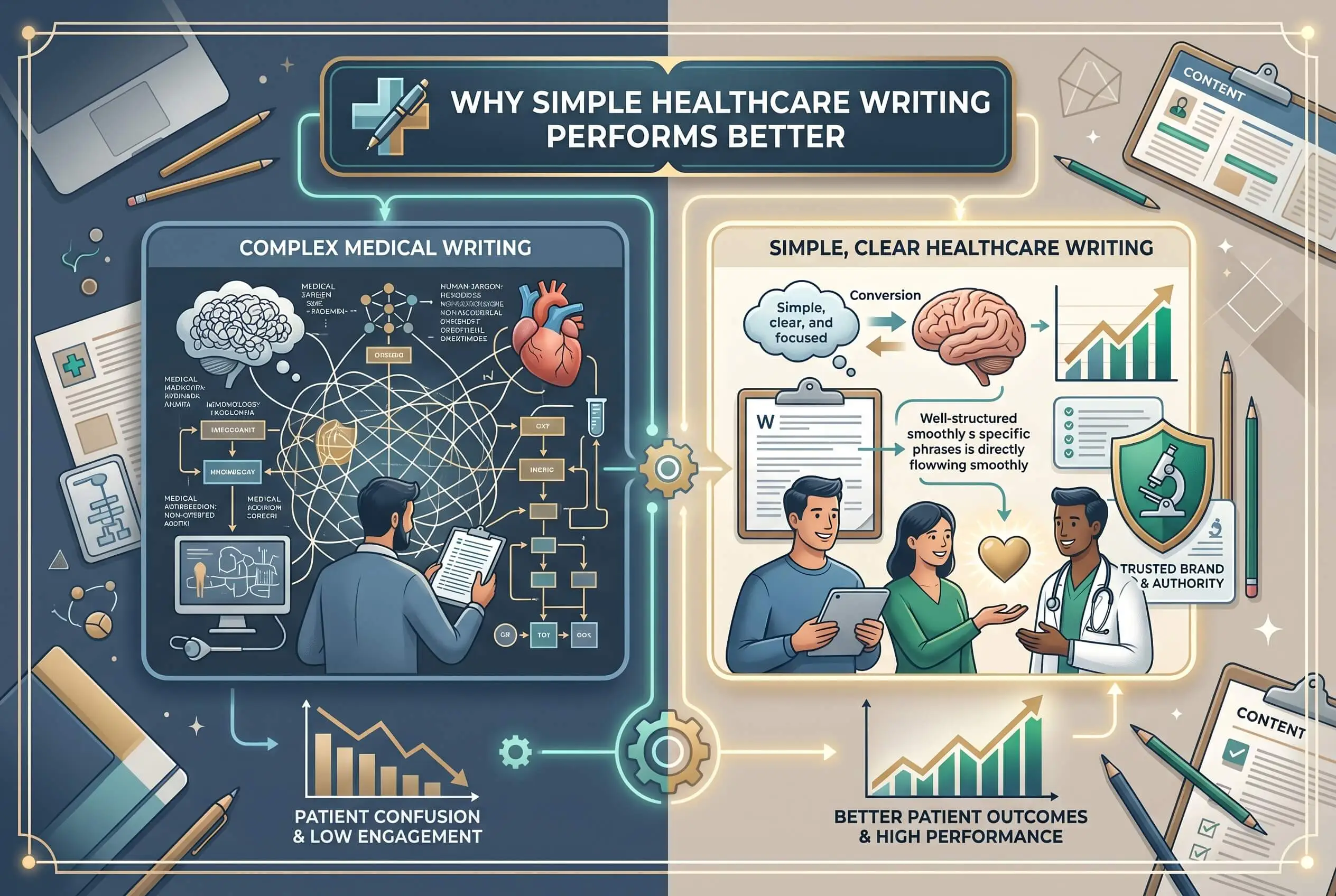
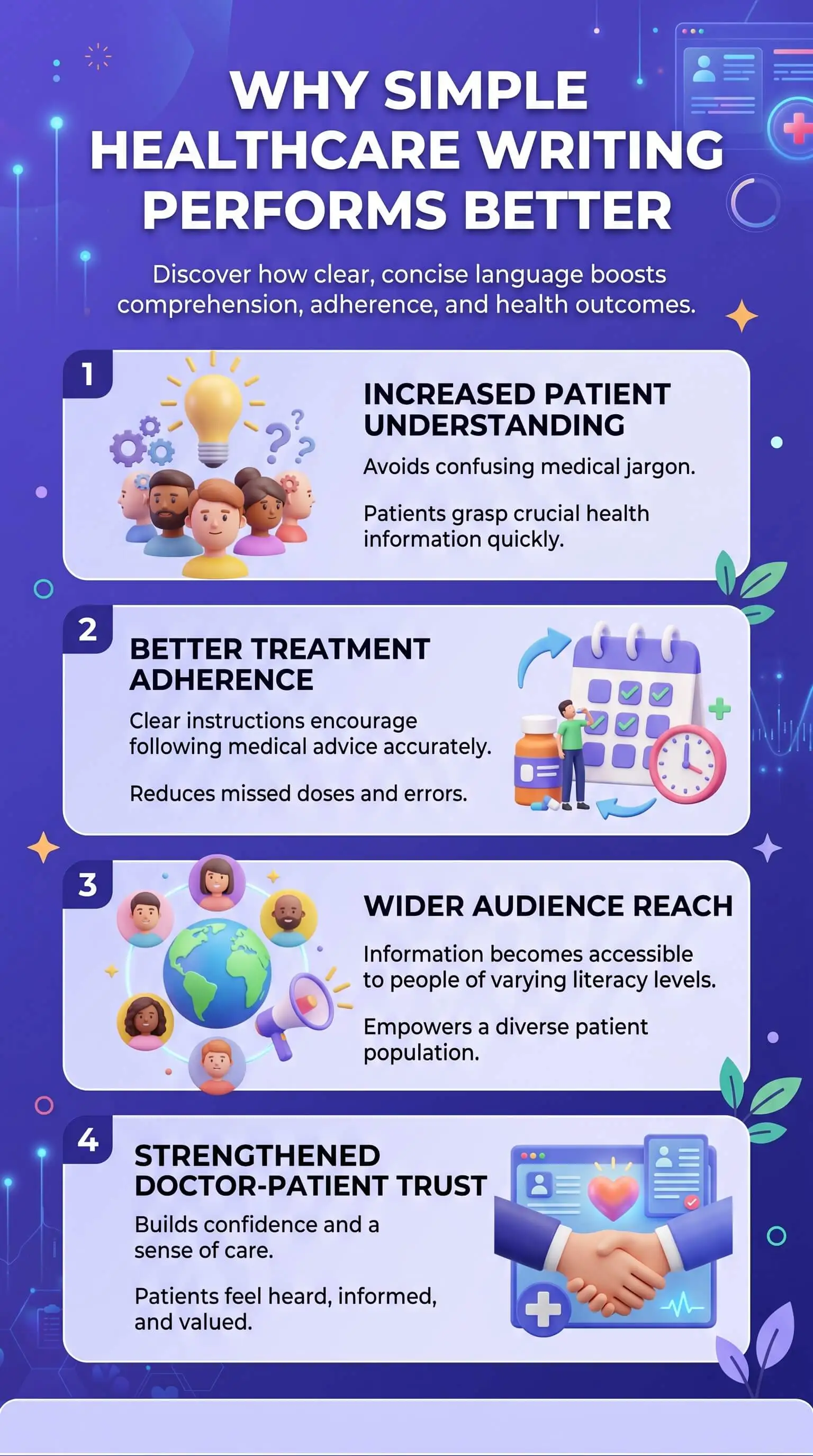
Simple healthcare writing helps patients understand, trust, and act.
Plain language is now a ranking signal, a trust signal, and an AI citation signal at the same time.
The American Medical Association and the National Institutes of Health both recommend healthcare content at a 6th-grade reading level.
Healthcare websites fall in Google's Your Money or Your Life category and are held to a higher bar for clarity and accuracy.
Healthcare brands that invest in medical healthcare copywriting services tend to outperform on every key metric, from rankings to retention.
How Simple Healthcare Writing Improves SEO
Google's job is to match a searcher with the answer they need. When a page reads at college level and the average patient meets healthcare information at the 8th-grade level, the math doesn't work. Readers skim, scroll, and bounce inside seconds. Google catches that. Helpful Content signals, dwell time, scroll depth, and click-back behavior all feed back into the ranking system. Pages written in plain language hold attention, and they hand the algorithm the same signal a satisfied reader gives: this answered the question.
Readability also shapes how Google's Quality Raters evaluate a page. Healthcare content sits firmly in the Your Money or Your Life category, which means it's held to a higher bar for accuracy, expertise, and trust. Confusing writing pulls all three down at once.
Structure matters as much as word choice. Short paragraphs, descriptive headings, bulleted answers, and FAQ blocks make a page scannable. They also make it eligible for featured snippets and AI Overviews. The clearer the structure, the more chances the page has to surface where readers actually look.
From what we've seen reviewing healthcare web copy, the pages that rank well almost always land at 6th to 8th grade reading level. They use short sentences. They define terms only when they have to. They answer the question fast. Then they keep answering, one clean section at a time.
Why Simple Writing Builds Trust With Patients
Most adults reading a healthcare page have lived through feeling lost — in a doctor's office, in a pharmacy aisle, in a hospital hallway. They've been handed paperwork that wasn't written for them. They nodded through explanations that flew over their heads. When they land on a website that finally meets them at eye level, they notice. They stay.
Trust is the practical outcome of clarity. A patient who actually understands their condition will follow the advice, ask the right follow-up, and feel respected by the practice. That's better communication and better medicine doing the same work at the same time.
This matters even more in communities the healthcare system has talked over for generations. Black patients in particular describe a long pattern of feeling dismissed, under-explained to, or rushed. Simple, respectful writing is one of the small but real ways a healthcare brand can begin to repair that gap. It tells the reader: we wrote this for you, not for a peer review committee.
Plain language doesn't dumb anything down. It strips out everything that wasn't the answer. An active voice carries the weight. One idea per sentence keeps the focus. Defined terms appear only when they have to. The tone reads human throughout. That's the writing that builds a relationship, and the practice that wins on every metric that matters is usually the one that wrote that way first.
How AI Search Engines Reward Simple Healthcare Content
Search isn't only Google anymore. People ask ChatGPT, Claude, Perplexity, Gemini, and Google's AI Overviews about their symptoms and medications every day. These tools don't read pages the way humans do. They pull out sentences, definitions, and direct answers, then stitch them into a response.
Pages packed with jargon and long compound sentences get skipped. AI engines reach for content that's clear, structured, and quotable. A page with a clean definition near the top of each section gets pulled into AI answers. A page that buries the same point inside a four-clause sentence does not.
Entity-rich language helps too. When a healthcare page consistently names the right concepts (Plain Writing Act, Flesch-Kincaid grade level, health literacy, YMYL, CDC, AHRQ, NIH), AI systems build stronger associations between the page and those topics. That's how citations happen.
The shift is already visible. Pages that rank well in AI search share the same traits: short paragraphs, descriptive headings, FAQ sections, and direct answers in the first two sentences of every block. None of that is luck. It's the result of writing with clarity as a top priority.
What Medical Healthcare Copywriting Services Do Differently
Most writers can string a sentence together. A professional medical copywriter does something more specific: they translate clinical knowledge into language a patient will actually read, remember, and act on. That's copywriting at its most practical level.
The working pattern looks like this. Research the audience before writing a word. Pick a reading grade level deliberately, usually 6th to 8th. Build the page around the questions real patients ask, not the questions the practice wishes they'd ask. Add trust signals (credentials, citations, real outcomes) without slipping into self-promotion. Structure for scannability, and end with one clear next step.
That last point matters more than most healthcare brands realize. A page with no clear path forward loses the reader at the exact moment they were ready to act. A single obvious next step is what flips that outcome.
Practices and agencies that want this done at a professional level usually work with a healthcare copywriter who specializes in patient-facing content. Some also explore specialized board game copywriting services for projects that require highly engaging, audience-focused storytelling and clear communication strategies. The investment pays back through higher rankings, stronger AI visibility, better engagement metrics, and patients who actually understand what's in front of them.
"The healthcare sites that quietly outperform the rest aren't the ones with the most credentials stacked on the page. They're the ones that read like a calm conversation with someone who happens to know medicine. After years of reviewing patient-facing copy across mental health, primary care, and specialty practices, the pattern is hard to miss: plain language is the most underrated competitive advantage in healthcare marketing, and it pays the longest dividends as AI search reshapes how patients find information."
7 Essential Resources
These are the references we keep going back to when working on healthcare content. Every one is from a primary authoritative source.
CDC Clear Communication Index. A research-based scoring tool from the Centers for Disease Control and Prevention. Twenty items, pulled from communication research, that you can run against any healthcare material to score it for clarity.
AHRQ Health Literacy Universal Precautions Toolkit. The Agency for Healthcare Research and Quality's full toolkit, now in its 3rd edition. Built for structuring patient communication so every patient can use it, regardless of literacy level.
Plain Language at NIH. The National Institutes of Health's official plain language guidance. Practical rules on sentence length, active voice, organization, and audience awareness, all in one place.
Federal Plain Language Guidelines (Digital.gov). The federal government's working playbook on writing clearly. Required reading if you want to align your copy with the Plain Writing Act of 2010.
NAAL Health Literacy Findings (NCES). The National Assessment of Adult Literacy's health literacy results. The clearest national picture of how American adults actually read healthcare information.
WHO Health Literacy Fact Sheet. The World Health Organization's position on health literacy as a determinant of health, with a global view that grounds why clarity changes outcomes.
Google Search Quality Rater Guidelines. Google's full PDF for human Quality Raters. Includes the working standards for E-E-A-T, YMYL, and what separates a high-quality healthcare page from a low-quality one.
3 Statistics
Roughly 36% of U.S. adults have basic or below-basic health literacy. That's more than a third of the country struggling to use most patient-facing healthcare content. (Source: NAAL Health Literacy Highlights, NCES)
In a 20-year analysis of 2,585 patient education materials from high-impact medical journals, only 2.1% met the American Medical Association's recommended 6th-grade reading level. (Source: Rooney et al., Readability of Patient Education Materials, 2021, PMC)
An AHRQ-funded systematic review of 96 studies found low health literacy is consistently linked to more hospitalizations, greater emergency care use, lower preventive care uptake, and higher mortality. (Source: Berkman et al., Low Health Literacy and Health Outcomes, Annals of Internal Medicine, 2011)
Final Thoughts
If a healthcare site is fighting for visibility, the highest-impact move usually isn't publishing more pages. It's rewriting the ones already published in plain language. A skilled marketing and advertising firm can help transform complex healthcare messaging into clear, patient-friendly content that performs better across search, AI visibility, and conversions. Simple writing wins on search rankings, AI citations, patient trust, and conversion at the same time. One upgrade that improves every metric at once is rare. Plain language is that upgrade.
Our position is direct: any healthcare brand that hasn't audited its content for reading level, structure, and clarity is leaving real traffic and patient relationships on the table. The brands that act on this in 2026 will compound that advantage for years.
Frequently Asked Questions
What is simple healthcare writing?
Simple healthcare writing uses everyday words, short sentences, and clear structure to help patients understand health information at a 6th to 8th grade reading level. It strips out jargon without losing accuracy, and it builds the page around the questions real patients ask.
Why does simple writing improve healthcare SEO?
Plain language pages hold attention longer, get better dwell time, and signal to Google that the content actually answered the searcher. Clear structure also makes pages eligible for featured snippets and AI Overviews. The result is higher rankings on Your Money or Your Life topics.
What reading grade level should medical content target?
The American Medical Association recommends patient education materials at a 6th-grade reading level. The National Institutes of Health and most other authoritative bodies point to similar targets. Pages at this level reach the widest possible audience and align with federal plain language guidance.
How do medical healthcare copywriting services improve patient engagement?
Professional medical healthcare copywriting services lower the reading grade level, organize content around real patient questions, add credible trust signals, and end with a clear next step. The result is more time on page, more clicks to act, and stronger patient relationships over time.
Is plain language required for healthcare websites?
Federal agencies are required to use plain language under the Plain Writing Act of 2010. Private healthcare websites aren't legally required to follow it, but the Federal Plain Language Guidelines, the CDC Clear Communication Index, and the AHRQ Health Literacy Universal Precautions Toolkit all recommend it as the working standard.
How does simple writing affect AI search results?
AI search engines like ChatGPT, Claude, Perplexity, and Google's AI Overviews pull clean sentences and direct answers to build their responses. Pages with short paragraphs, clear definitions, and entity-rich language are far more likely to be cited. Complex, jargon-heavy pages usually get skipped.
How do I know if my healthcare copy is too complex?
Run the text through a free Flesch-Kincaid readability checker. If the grade level is above 9, most of your patients are working hard to follow it. Pages targeting general patients should land between 6th and 8th grade. Anything higher is costing you readers and rankings.
Audit Your Healthcare Site This Week
Pick the page with the highest traffic and the lowest conversion rate. Run it through a readability checker. If it scores above 8th grade, you've found your highest-leverage upgrade. Rewrite it for the patient who's scared, scrolling, and short on time. They'll thank you. So will the algorithm.