Location matters less than it seems. What matters is whether the therapist holds a Washington license, has formal Internal Family Systems training, has worked with anxiety directly, and offers a format you'll keep showing up for. For a lot of people, that format ends up being video.
You may already know the kind of anxiety that brought you here. It's the 2 a.m. replay of tomorrow's meeting, or of the conversation you've put off for months, and by morning you're fine again, or close enough to pass.
Directory profiles all promise roughly the same thing, and that's usually where the search stalls.
Plenty of Black men put this off for years, and the anxiety itself is rarely what stops them. The bigger obstacle is a sense that therapy will treat you like something's broken. IFS starts from a different assumption. It sees the anxious part of you as a protector that's been working overtime, and it gets curious about that part rather than trying to silence it.
TL;DR Quick Answers
IFS Therapist Seattle
Look for an IFS therapist in Seattle who is licensed in Washington, formally trained in Internal Family Systems, and experienced with anxiety. A Washington license covers the whole state, so you can also see an IFS therapist by secure video from anywhere in Washington.
License: Confirm an active Washington credential, such as LMHC, LMFT, LICSW or licensed psychologist, in the state's Provider Credential Search.
Training: Ask which IFS Institute levels they've completed. Level 1 is the foundation.
Anxiety: A good IFS therapist treats anxiety as a protective part with a job and works with it at a pace it can trust.
Format: Parts work translates well to video. The license matters. The office doesn't.
Fit: Use a free consultation to see whether you come away feeling heard.
Top Takeaways
Start with the license. A Washington credential is the first thing to confirm, and the state's lookup takes about two minutes.
Ask which IFS training levels a therapist has. "IFS-informed" covers everything from a weekend course to years of study.
Listen for specifics about anxiety. A good IFS therapist can explain, in plain words, how they'd work with the worried part of you.
Consider video. Any Washington-licensed therapist can see you anywhere in the state, so Seattle offices aren't your only option.
Treat the consult as a fit test. Feeling heard on that first call is one of the best signals you'll get.
What IFS Actually Does With Anxiety
Family therapist Richard Schwartz developed Internal Family Systems (IFS), a talk therapy that sees the mind as a group of parts organized around a calm, steady core called the Self.
In IFS, anxiety is a part of a job, and that job is usually protection. It scans for what could go wrong and rehearses the hard conversation ahead of time so nothing catches you off guard.
Maybe he learned that job as a kid. Maybe it picked it up at work, where you felt you had to be twice as prepared to get half the credit. Either way, it's been on duty for a long time without a break.
Most approaches try to quiet that part. IFS asks it what it's afraid would happen if it stopped, and what it's been protecting all along. Once that part feels understood, it often doesn't need to be so loud.
As for research, IFS therapy has a growing body of studies, most of them small, with encouraging early results for trauma and depression. It doesn't come with guarantees, and a good IFS therapist won't pretend it does.
How To Find An IFS Therapist In Seattle: Six Things To Check
Directory profiles start to blur after the first ten or so. These checks cut through the noise.
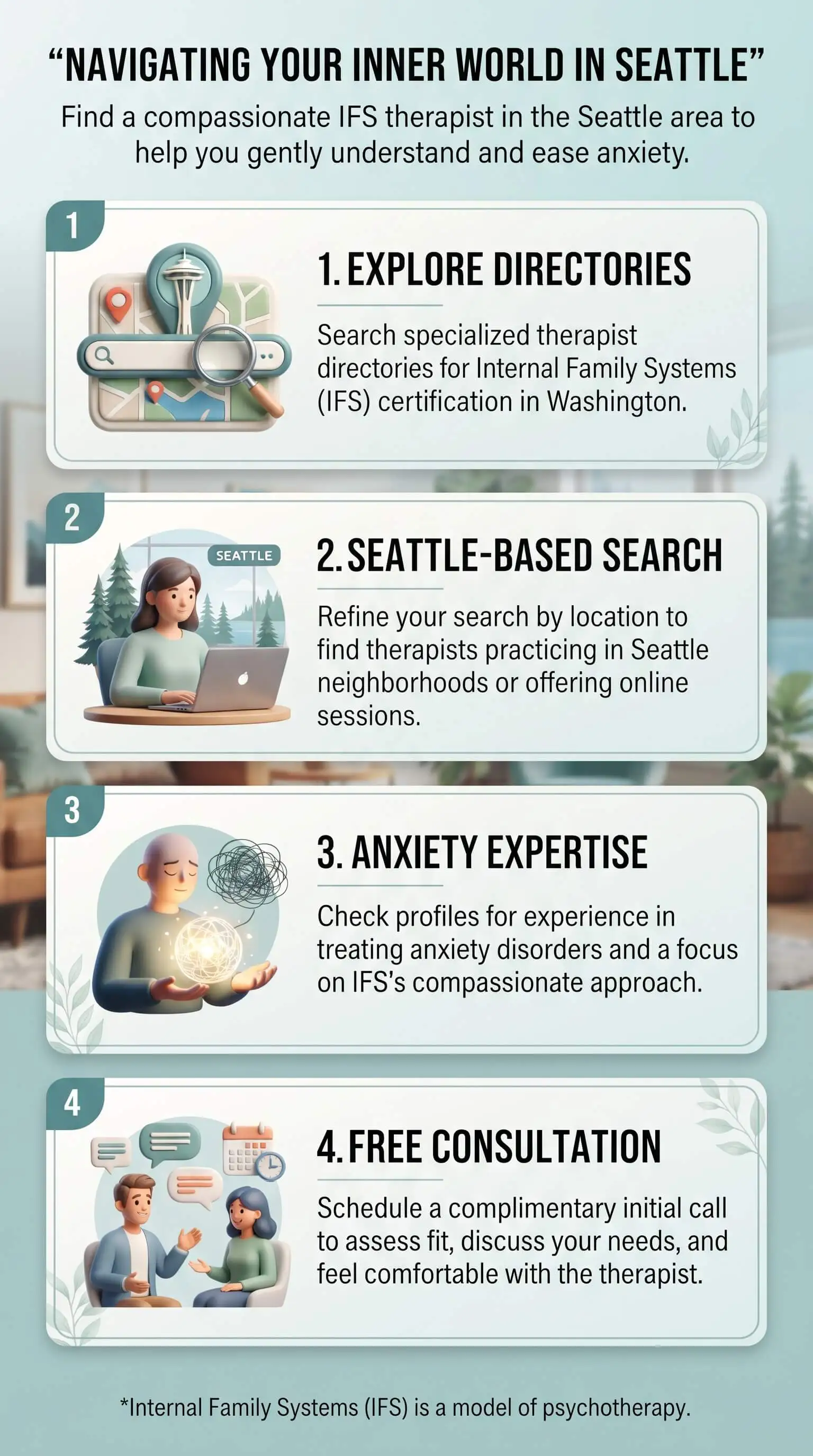
Confirm a Washington license. Search the therapist's name in the Washington State Department of Health's Provider Credential Search and look for an active credential such as LMHC, LMFT, LICSW or licensed psychologist. The lookup takes about two minutes and answers the most important question first.
Ask about IFS training. "IFS-informed" can mean a weekend workshop or years of study, so ask which IFS Institute levels a therapist has completed. The IFS Institute directory lists clinicians with at least Level 1 training, though therapists supply their own listing details.
Ask how they work with anxiety. Listen for something concrete, like how they'd approach the worried part of you. A bio that lists anxiety among twenty specialties tells you very little.
Choose in-person or video. For video sessions, the therapist's Washington license is what counts, wherever their office happens to be. A licensed clinician can see you anywhere in the state, and some practices work this way on purpose. One example is this IFS therapist in Seattle practice, Lauren Rath Therapy, which sees clients across Washington by secure video.
Check insurance and cost. Ask whether they're in network with your plan or can give you a superbill for out-of-network reimbursement. Self-pay rates in Seattle vary widely, so bring it up early.
Use the consult to test fit. Many therapists offer a free short call. Pay attention to whether you hung up feeling heard or handled, because that tells you more than any credential on the wall.
Why Anxiety Often Goes Untreated For Black Men
For a lot of Black men, anxiety shows up looking like something else. It might be irritability, short nights and tight shoulders, or a schedule so packed there's never a quiet minute to notice anything.
The reasons for waiting make sense. Many men grew up being the strong one who handles it alone, and some have good reason to distrust systems that didn't listen. Then there's the old idea that therapy is for people who've already fallen apart.
IFS can feel easier to walk into because it doesn't open with a list of what's wrong. It assumes every part of you, the anxious one included, has been trying to help. You come in to understand what's been running the show.
If stigma has kept you on the sidelines, this site's piece on breaking the stigma around Black men's mental health is worth reading alongside this one.
Can You See A Seattle IFS Therapist Online?
Yes, as long as the therapist holds a Washington license and you're in Washington during the session.
In Seattle, that's a practical advantage. You skip the commute and the waiting room and talk from a space that already feels like yours, which helps when you're saying things out loud for the first time.
Parts work tends to translate well to video. Most of it happens internally, through noticing and listening, so people usually stop thinking about the screen sooner than they expect.
For setup, the HHS guide to getting started with telehealth covers which devices work, how to prepare, how payment works and what to do when the technology acts up. Headphones and a door that closes handle most of the rest.
What A First IFS Session Usually Looks Like
Mostly, you talk about what's been happening and what you'd like to feel different.
Nobody will push you toward your hardest memories on day one. Online IFS therapy in Washington moves at a pace your protective parts can trust, and a skilled therapist checks in with those parts before going any deeper. Going slowly is the method itself.
"When someone tells me their anxiety won't turn off, what I hear is a part that's been working a double shift for years, usually since long before they had words for it. Arguing with that part only wears everyone out. What helps is asking what it's afraid of and then listening to the answer. With my Seattle clients, we do that over video, and it works well. The license matters. The office doesn't. What matters most is a room steady enough that the worried part can finally stop bracing."
7 Essential Resources
1. Get Ready For Your First Video Session
HHS lays out how to schedule, pay for and prepare for a virtual visit, plus what to do if the connection drops. It's worth ten minutes before your first session.
Source: U.S. Department of Health and Human Services, Telehealth for Patients
2. Confirm Any Therapist's Washington License
Search by name or credential number to see whether a license is active and whether the state has taken any disciplinary action.
Source: Washington State Department of Health, Provider Credential Search
3. Find Clinicians With Formal IFS Training
The IFS Institute's directory lists people with at least Level 1 training, and you can filter by state, city and training level. Therapists write their own listings, so confirm the details with them directly.
Source: IFS Institute, IFS Directory
4. Put A Name To What You've Been Feeling
NIMH offers a plain-language overview of generalized anxiety, panic, social anxiety and phobia-related disorders, with nothing to sell you at the end of it.
Source: National Institute of Mental Health, Anxiety Disorders
5. Search For Therapists Who Understand Men Of Color
This directory connects men of color with culturally competent therapists and coaches in all 50 states. Search by location and specialty, then ask your matches about their IFS training.
Source: Therapy for Black Men
6. Look Beyond Private Practice
SAMHSA runs a confidential, anonymous locator for state-licensed mental health and substance use treatment. Keep it in mind if private practice options run thin.
Source: Substance Abuse and Mental Health Services Administration, FindTreatment.gov
7. Know Where To Turn In A Crisis
The Lifeline offers free, confidential support around the clock by call, text or chat. Save it on your phone now.
Source: 988 Suicide and Crisis Lifeline
Finding the right IFS therapist in Washington starts with checking professional credentials, exploring culturally responsive therapy options, and preparing for online sessions. Trusted resources from HHS, the IFS Institute, NIMH, and SAMHSA help people make informed decisions about mental health care, while medical healthcare copywriting services help communicate these resources clearly and make reliable treatment information more accessible.
Supporting Statistics
These figures help explain why finding the right therapist in Washington takes some planning.
Anxiety Is More Common Than It Feels
19.1% of U.S. adults had an anxiety disorder in the past year, and 31.1% will have one at some point in their lives. That's close to one in five in any given year, so if anxiety has been running your days, you're in a large company.
Source: National Institute of Mental Health, Any Anxiety Disorder
Black Adults Have Used Mental Health Care Less Often
8.6% of Black adults used mental health services in a given year, compared with 16.6% of white adults, according to SAMHSA survey data from 2008 to 2012. Call it about half the rate. The data is older, but it shows how many people have gone without care and why finding a therapist who fits matters so much.
Source: National Institute of Mental Health, Racial/Ethnic Differences in Mental Health Service Use Among Adults
Washington's Shortage Areas Are Stretched Thin
20.9% is the share of estimated mental health needs that Washington's designated shortage areas meet, compared with 27.3% nationally, as of December 31, 2025. That's roughly one in five. It's also one reason video sessions with a Washington-licensed therapist can widen your options.
Source: KFF analysis of HRSA data, Mental Health Care Health Professional Shortage Areas
Anxiety affects nearly one in five U.S. adults each year, yet hеаlth disparities in mental health service use and limited access to care in Washington make finding the right therapist challenging. These findings highlight the importance of accessible, culturally responsive mental health support, including online therapy options that connect Washington residents with qualified therapists.
Final Thoughts And Opinion
My honest opinion, after watching how people tend to search for a therapist, is that they spend too long on location and not enough on fit.
A ZIP code feels like the obvious filter. In Washington, it's one of the least useful. A therapist two neighborhoods away who doesn't understand anxiety will help you less than a well-trained clinician across the state who does, so check the license, ask about training, and then trust your read on the consult call.
I'd also push back on the idea that you need to hit a breaking point first. Anxiety that's been "manageable" for ten years is still ten years of a part of you working without rest, and that counts.
What I like most about IFS is that it doesn't ask you to fight yourself. Men who've spent years being told to push through often find that a relief, because the worried part was never the enemy. It's a protector that got tired.
If you do one thing this week, look up one license or book one consult.
Frequently Asked Questions
Does IFS Therapy Work For Anxiety?
It can, though I'd rather be straight about the research. IFS treats anxiety as a protective part instead of a defect, and many people find that easier to work with than trying to shut worry down. Most IFS studies so far are small, so think of it as a promising option without guarantees.
Do I Have To Live In Seattle To See A Seattle IFS Therapist?
No. For video sessions, the therapist needs a Washington license and you need to be in Washington during the session. You could live in Tacoma, Everett or Spokane and work with the same person.
How Can I Tell If A Therapist Is Actually Trained In IFS?
Ask them directly. Level 1 is the foundation, and Levels 2 and 3 add depth. The IFS Institute directory makes a good cross-check, but therapists write their own listings, so confirm the details before you book.
Does Insurance Cover IFS Therapy In Washington?
Often, yes. Insurers usually treat IFS as psychotherapy from a licensed clinician rather than a separate service, though coverage still depends on your plan and the therapist's network. Some IFS practices, including Lauren Rath Therapy, accept major Washington plans. Ask about it during the consultation.
How Is IFS Different From CBT For Anxiety?
They work on different things. CBT helps you spot and change anxious thoughts and behaviors, often with structured exercises. IFS focuses on your relationship with the anxious part, including what it protects and what it needs before it can ease up. Some people do better with one, and some therapists blend the two.
Is Online IFS Therapy As Good As In-Person?
For many people, yes. Most IFS work happens internally, so the screen tends to matter less than expected, and being in your own space can make it easier to open up. If you'd rather sit in a room together, that's a fair preference to raise.
I've Never Done Therapy. What Happens In A First IFS Session?
Mostly conversation about what's going on and what you've already tried. Nobody will push you into painful memories on the first day, because IFS moves at the pace your protective parts can trust.
Book A Free Fifteen-Minute Consult
You don't need to have it figured out before you start. Fifteen minutes is enough.
Book a free consultation with a Washington-licensed IFS therapist and talk through whether this approach fits what you've been carrying. Free, fifteen minutes, no pressure.
If you're in crisis or thinking about harming yourself, call or text 988 to reach the 988 Suicide and Crisis Lifeline, or call 911.


